

LOVECRAFT COMES ALIVE!
AI Presents: Things That Should Not Be

What we did see—for the mists were indeed all too malignly thinned—was something altogether different, and immeasurably more hideous and detestable. It was the utter, objective embodiment of the fantastic novelist’s ‘thing that should not be.’
- HP Lovecraft
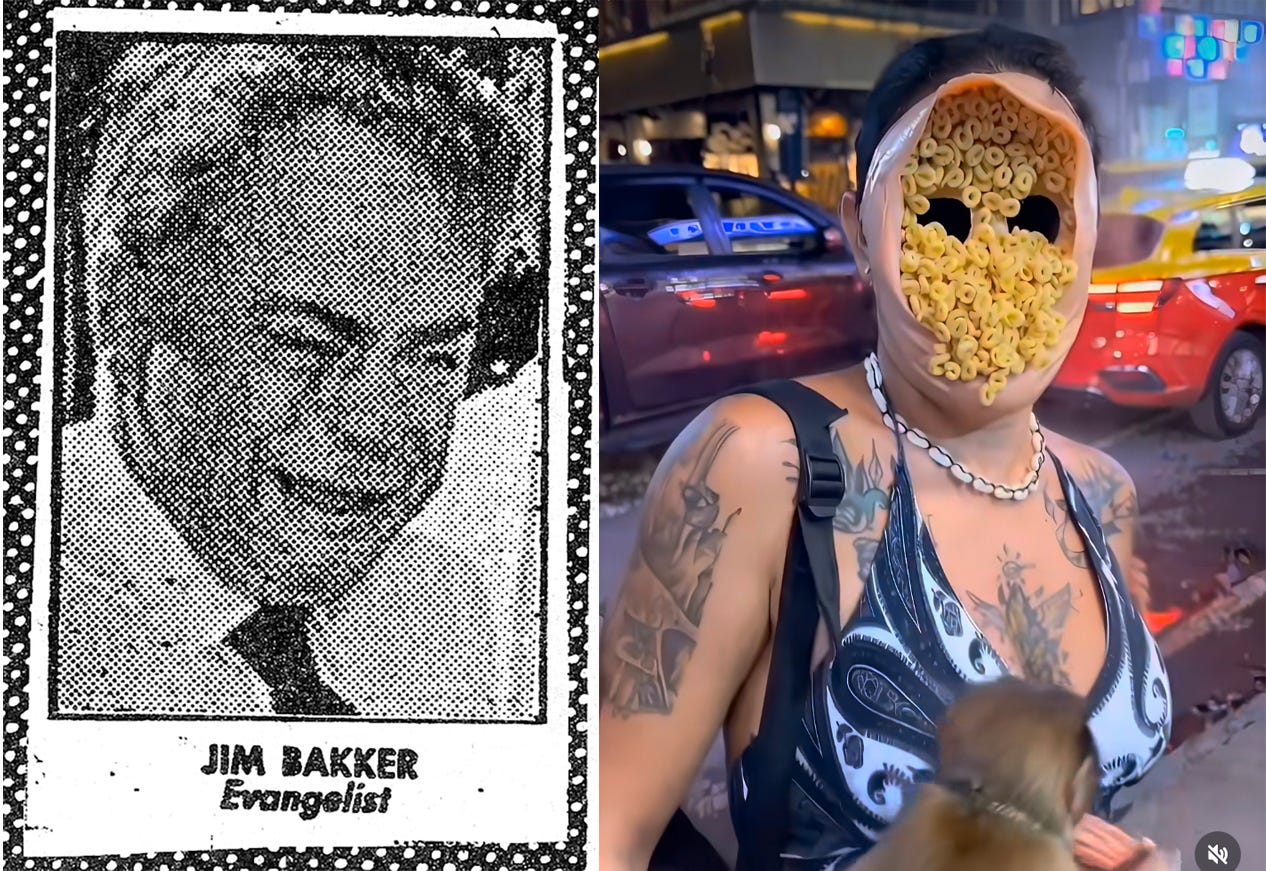
Few villains of 1980s America so neatly spanned the decade as Jim Bakker. Throughout the eighties, he and his wife, Tammy Faye Bakker, grifted their way into millions of dollars through their glitzy conservative mega-ministry, Praise The Lord. Busted for sex and financial crimes, he went to jail for the latter. During his 1989 trial Jim had a psychotic breakdown in his lawyer’s office, claiming that he was seeing huge and terrifying insectile monsters roaming the courthouse. Eventually, he was coaxed out from under his lawyer’s couch, evaluated, and returned to trial, at the end of which he was given 45 years in prison.
In 1991, on tour, I met several people who told me they’d lived near this courthouse. They said they’d heard the breakdown story on the news, then quickly whipped up several huge papier-mâché insect costumes, and marched around on the pavement outside the courtroom attempting to make him more insane. Maybe I misunderstood, or maybe they were exaggerating, or it wasn’t true. Doesn’t matter. It’s not just a good story. Almost immediately, I saw it for what it was: a template for action, one that could be used indiscriminately.
For the last few months I’ve thought of Jim Bakker, sobbing and insane, every time I’ve logged on to Instagram. Sometime earlier this year, various AI-based art accounts started showing me visions of the deeply insane. In one photorealistic video vignette after another, faces and bodies split apart like overripe fruit. Humans grow and lose appendages, their bodies inflating, bursting, gushing, becoming unspeakable whirlwinds of orifices and tongues and membranes and hair. Gravity and solidity and sanity are out the window. Many of the videos depict people eating pets, although it’s important to note that the pets turn into food—usually cake, but also egg yolks or Cheetos dust—at the moment of consumption. Sometime pets emerge from pools of custard, or gaping throats, or impossible orifices. These scenes are bloodless, and although bloodless gore reads differently, it’s still rough. Every possible phobia gets airplay. New phobias emerge.1 Many of these vignettes mirror the most fucked-up dreams I’ve ever had, dreams I would never tell anyone about, dreams that shocked me. I strongly suspect everyone in our species has such nightmares—things we never expected to see pop up on social media.2
I can’t tell if these images are doing me damage. My best guess is not yet. In the early days of the internet, every guy I knew felt compelled to peek at rotten.com, a now-mercifully-defunct shock website featuring explicit photos of carnage and human horror. The one photo I saw on that site haunted me for years. But I write with the understanding that I only glimpsed this photo once; I could have easily acclimated myself through repeat exposure. I know this from all the horrible images I’ve seen as band graphics and record covers. In Portugal, earlier this year, I walked streets littered with discarded cigarette packaging showing tumors and stomas. As with most countries on Earth, the rough imagery is intended to revolt smokers into quitting. I’ve read there’s data indicating this works, but everywhere I went, these grisly little pictures winking up from street trash seemed to confirm that everyone has long since stopped processing these pictures as anything to be shocked by.
In Susan J. Eischeid’s 2024 book Mistress of Life and Death, the author describes “the Rabbits of Ravensbrück,” a particularly obscene Nazi human experimentation program. She writes,
Postwar photographs of these wounds prompt visceral incredulity and dismay, the observer’s thoughts darting about like mice in a trap, the mind refusing to accept what the eyes are seeing.... Of the many horrifying images to come out of the Holocaust, these are some of the worst.
I’ve never seen these images (unless they were used on a punk band’s record art, a demoralizing possibility I can’t 100 percent rule out), making Eischeid’s quote my only clue to their existence. If I did seek out these photos, I could accustom myself through repeat exposure. The description gives the images a type of horrific persistence the photos themselves don’t have.
I’ve long wondered if fake traumatic content could damage a human psyche as much as real traumatic content. These nightmare AI accounts seem to confirm that no, it won’t. These images usually leave me more annoyed than traumatized. It’s like watching a bad horror movie. My main emotion is irritation.
But there’s another clue in Karen Hao’s excellent Empire of AI: Dreams and Nightmares in Sam Altman’s OpenAI (reviewed here last month). She profiles Okinyi, a Kenyan data worker hired by a contractor, themselves hired by OpenAI, to provide a form of content moderation. Except this content wasn’t social media posts, or even human output. Instead, Okinyi had to read a torrent of AI-written micro-stories depicting horrific and graphic sexual abuse, with the goal of helping OpenAI to train their programs to refrain from writing such things for the general public. At 15,000 stories a month, a normal 40-hour work week would require reading and rating each story at the rate of slightly more than one per minute. Each story paid three cents. The work was degrading and traumatizing, and by the time OpenAI pulled the contract, Okinyi’s marriage had shattered.
All this from fake traumatic content. Perhaps the unending cascade of material is what bridged the gap between irritation and trauma. Or maybe the written word is a more effective vector for mental undoing than imagery is. I have a feeling we will be collectively puzzling over this question for the next few years.
The human bugs frolicking outside Jim Bakker’s jail point towards another possibility; weaponized insanity. The applications are endless. It could be used for widespread political attacks, or to destabilize entire populations. It could be used to belittle, defraud, hack, prank or stalk targeted individuals. It could be anonymous and purposeless spam. It could be deployed by an AI acting on its own, with no human input.
A few months ago, I caught a brief nano-craze where young people tricked their grandparents into believing Grand Theft Auto gameplay showed real-life freeway catastrophes. Boomers have worsening eyesight and twentieth-century sensibilities, making them especially vulnerable to AI trickery. So how will this population react the first time their favorite characters from CSI melt and deform? How about when their favorite grandchild melts on their computer screens? What happens then?
If you’re curious, go to Instagram and check out @fullwarp, @infiniteunreality, @synthetic_pink, or @voidstomper. I’m not linking to any. I don’t want to make it easy.
When I started taking an SSRI in 2014, I was warned to expect several side effects from the increased serotonin my brain would be squirting into my bloodstream. One was gastric (which, CHECK). The other was to expect “weird nightmares.” These dreams held steady for a month or so, and involved only one theme, over and over again: skinning dogs with a large knife. These nightmares only registered as nightmares upon waking. In the dreams, the ritual was as humdrum as brushing my teeth. Looking online, I was shocked to find other people on the same specific drug reporting the same specific nightmare. All of us with the knife, all of us with the dog.
The papier-mâché insects outside the courthouse weren’t satire so much as a form of sympathetic magic, an acknowledgment that he’d dragged everyone into his nightmare and they’d decided to play along. The AI grotesqueries you’re describing feel like the same thing—hallucinations we’ve chosen to mass-produce, to circulate like poisoned air. It’s not that they’re frightening, it’s that they’re boring, and that’s worse. When cruelty becomes a loop, endlessly generated, it stops resembling cruelty at all. It’s just wallpaper.