

S1:E1
An interview with Nadia Magnenat Thalmann

I sometimes view the entirety of social media as one long, strange television show, one in which every character can now impersonate every other character, in real time and with photorealistic precision. If this actually was a TV show, its pilot episode—season one, episode one; S1: E1— would have to be the 1987 short Rendez-vous in Montreal. This brief film ‘stars’ Humphrey Bogart and Marilyn Monroe in a ghostly nightcap that is both sweetly charming and slightly unsettling.
I recently spoke with the creator of that film, Nadia Magnenat Thalmann, from her home in Geneva. We discussed her early CGI work, and her 21st-century turn to robotics.
You hold advanced degrees in biology, biochemistry, psychology, and quantum physics. So how did you arrive at computer imagery in the 1980s?
When I worked on my PhD in quantum physics, I was among the first to explain the behavior of electrons when they meet in orbitals to create a new molecule. It was quite complex. My PhD was in ’77, and I was incredibly interested to visualize. So, I started to program in Pascal, a program that can visualize, in 3D, the behavior of the orbital. Today, of course, that’s something anyone can develop. But at the time, I remember quite a lot of people were impressed because they’d never seen, visually, the behavior of these electrons in 3D.
You came at early CGI from a scientific background, not from an interest in film?
Absolutely. When I was studying biology, I was really motivated to visualize whatever was possible. And when I studied quantum physics, that’s a domain where it’s completely invisible. I was passionate: ‘Okay, how can I show their behavior in 3D?’ So that was part of my PhD, beyond the calculations. For me, it was always mandatory to be able to visualize the infinite nonvisible world. And when I defended my PhD, there were quite big names coming to see that, because they’d never seen anything like this. That encouraged me to go further. Soon after, I thought I’d like to model 3D humans.
Before I get to Rendez-vous in Montreal, I’d like to ask just a bit about Dream Flight, the first movie you made in 1982. How did that film come to be?
We worked with the film board of Canada, in Montreal, and with a student who was interested in filmmaking. Our part was to make the software. At that time, it was very difficult to make a full appearance of a person. So, we decided to make a first being, a stick figure we named ‘Hippie.’ This being was coming from his universe to New York, and he tried to communicate with humans in the film, but the humans didn’t react. So, he became mad and bombed New York. We got several awards.
That moment in the film—the humans refusing to react—looks like it required rotoscope.
Absolutely! There are many techniques. One technique is very much linked with physics. I mean, we’d written a program with the students of about, I don’t know, 12,000 to 14,000 lines of code at that time. So, when we see the simulation of the sea, or the fish in the water, or the hippie, it’s all made with physic-based models, using an extension of Pascal graphics language.
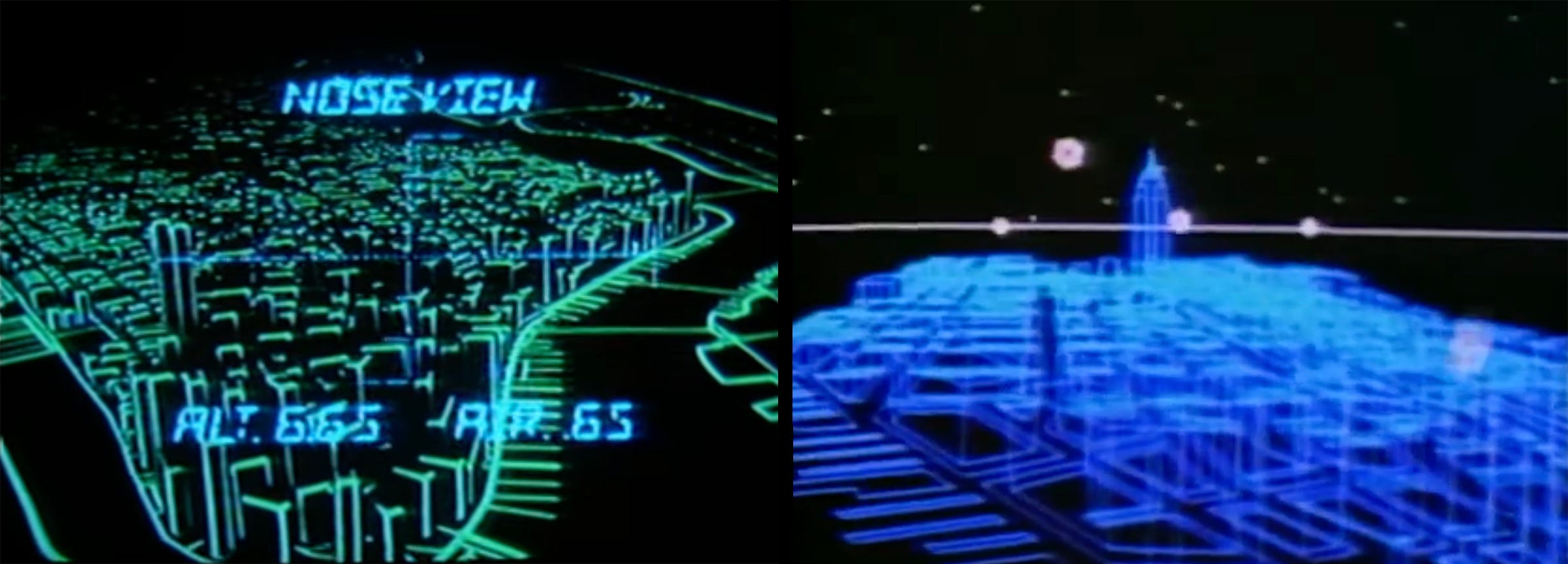
I was startled by the Manhattan cityscape of Dream Flight. Just a year earlier, there was a Hollywood film, Escape from New York, with a very similar scene. That film had a budget of $6 million, which still wasn’t enough for CGI in 1981. Their rendering of Manhattan had to be done physically, with an entire scale model of the island, lined with reflective tape and shot with black light.
I don’t know that film.
Well, I’m assuming the budget for Dream Flight was smaller.
There was almost no budget. You have to understand, we didn’t come from filmmaking. We came from science, so it was paid by our grants for research. We had masters and PhD students, but Philippe Bergeron was the main person in this making of the film. He had some contact with the film board in Montreal. We worked like mad for months on that. From then on, the National Film Board of Canada was interested because they thought our approach could be further developed.
There’s a five-year gap between the two films. How did Rendez-vous in Montreal come about?
Dream Flight was so cumbersome to make because we had to program everything. And then if you change something, you have to make another program. It took quite a lot of time. I think it took one year to make in parallel with the development of the language. The dream, at least for me, was to have designers included. Because I like to have their point of view, how they do films, and then they help us to define the interface and the platform in order so they themselves could create scenes. So the big change between Dream Flight and Rendez-vous in Montreal is that it was done by several people with an interactive platform we developed.
It shows. The pedestal shot of Bonsecours Market is breathtaking.
The great thing is you develop a system, but you are not alone. You have the talent of others. Everybody was learning from everyone. Almost nobody worked like that at that time. But it was a marvelous time. We worked on this day and night—including Christmas and New Year’s Eve—because the Association of Engineers in Canada were celebrating a hundred years of engineering, and they asked if they could show the film at their event. So you see, you had a deadline with something you never did before, and then it was a knife under the throat every minute.
That sounds pretty satisfying to complete.
Yes. Although you always expect better than what you produce. At the beginning, we thought we’d make the film longer. But at least we came out with Marilyn. When I look at her today, I still find her very nice.
Would it be correct to say that this was the very first depiction of specific humans with computer graphics?
Absolutely. At the time, there had been some cartoon depictions of humans, but not actual, real people. In my case, I like Marilyn Monroe. I like her style. I told the engineering people that we could do something more fantastic, like taking legendary stars and giving them life again. When we started in 1985, that was not something anyone thought about.
Is it true that the estate of Humphrey Bogart contacted you after the film’s release?
That is true. They contacted us and said that we didn’t have the rights to model him. I told them, ‘We are researchers, and we’re not selling it.’ And then they were quite okay.
Seven years later, an episode of Tales from the Crypt resurrected Humphrey Bogart again, as an homage to 1947’s Dark Passage. Perhaps Bogart’s estate had softened their views at that point. Had you ever seen that TV show?
No.
I often read of the span of time between the first airplane flight and the moon landing—66 years—as a hallmark of human progress. But I’ve always been more impressed that it was only 22 years between Rendez-vous in Montreal and Avatar. Did you see Avatar when it came out?
Yes. I must say that my husband, myself, and the students were very alone in 1987, because nobody really understood. Even the scientific community. They were telling us, “What is the purpose?” They saw absolutely no future for our technology. We were quite alone. And when you speak of Avatar, the first film like that, for me, was actually Jurassic Park. Jurassic Park couldn’t show CGI humans, but the 3D was fully there. From that time on, I lost my isolation as a researcher.
That must have been bittersweet.
We were supported in Japan. But creating realistic humans made no sense in Canada and the United States. It’s one reason why I later moved on with robots, in 2006; the domain was not yet so full.
Your take on robotics seems as playful as your films. For example, you modeled your robot Nadine after yourself, and then got her a job at an insurance company in Singapore.
We had quite a lot of collaborations in Singapore, since 2009. They are very open to this kind of technology. We arranged, along with other agents, for Nadine to work in an insurance company there. It was quite interesting to learn how robots adapt—or at least how the others adapt to a robot— and what the robot can be useful for. We have papers published on the reactions of people who worked with her. That was quite interesting. From a research point of view.
Well, all right. Thank you so much for talking with me!
Absolutely awesome to read this!