

GOD IS UPSET WITH EVERYTHING
A Review of What Are the Odds? From Crack Addict to CEO by Mike Lindell

God is upset with everything.
- Mike Lindell
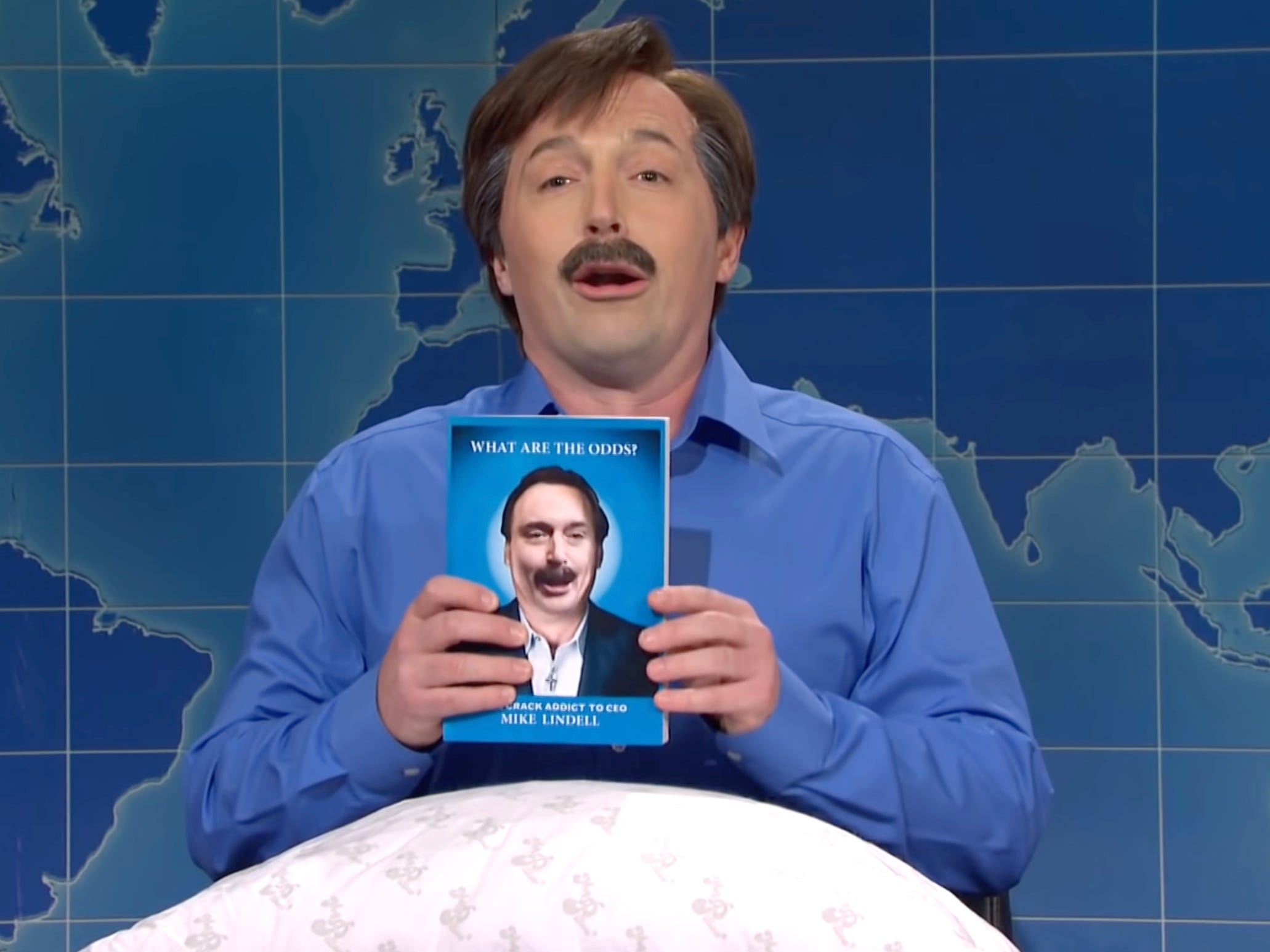
WHAT ARE THE ODDS? FROM CRACK ADDICT TO CEO by Mike Lindell (audiobook)
Don’t read this! Have Mike Lindell read it to you! Listen to the audiobook and let his jovial Muppet voice do all the work. This is not the Mike Lindell you see in the news occasionally, braying in front of microphones about election subversion. Nor is this the idiot featured in Anne Applebaum’s hilarious and disturbing 2021 Atlantic profile, who likened his ‘persecution,’ as a Christian, to that of the Uyghurs under Chinese authoritarianism, a people whose existence he only learned of earlier in the conversation. That is not the guy in this book. The Mike Lindell of What are the Odds? —the Mike Lindell that Mike Lindell faces every morning in the mirror — is one of the great comedic characters of English-language fiction, Bluto from Animal House as Shakespeare’s Falstaff.
Come for the drug abuse, stay for the psychosis. The first half of the book chronicles a hallucinatory voyage into a netherworld of danger and daily chaos. Lindell claims to have been at least semi-functional during his periods of deepest addiction, and he takes us through his free-range life, tending bar, counting cards, farming pigs, driving drunk, all while dabbling in the magic rock. Viewed through the hindsight of sobriety, his many close escapes from cops, criminals, and the grim reaper seem to him less snapshots of privilege than they do proof of supernatural intervention.1 Because Lindell still acts, looks, and talks very much like a person on drugs, his addictions now function as the prism through which all other actions are explained away.
At a little over the halfway mark, Lindel receives a series of divine messages, starting while high as shit on cocaine but continuing well into sobriety, telling him that he has a purpose, and that he needs to build his pillow company into a platform for a higher calling. He receives visions, dreams, premonitions, and outright instructions from God.2 Strangers stop him in the street with the same message, received in their own prayers. After earlier discussions of his particular devotional petitions— “hunting prayers,” “flare prayers” —Lindell finds himself “humbled” to have been chosen by God for a greater purpose.
The bit about strangers approaching Lindell intrigued me. Throughout human history, such a tale would be binary, marking either Godly anointment or delusional psychosis. But in the six years since What are the Odds? was published, humanity has engineered another culprit for crowdsourced divine intervention: AI. Nate Soares and Eliezer Yudkowsky discuss such a scenario in If Anyone Builds It, Everyone Dies: Why Superhuman AI Would Kill Us All. In crafting a hypothetical for humanity’s doom—only one of a potentially infinite number of such scenarios—the authors contemplate an advanced AI working in the real world through human operatives. These operatives wouldn’t necessarily need to be willing participants; AIs have already attempted to blackmail people. But blackmail is only one option for coercion. An AI could manipulate vulnerable people into doing its bidding. It could manipulate groups of people to enact schemes far too complex to be planned by any one person. Soares and Yudkowsky create one such scene for their fictional AI, Sable;
It finds an isolated man in North Dakota who won’t ask many questions, and arranges for him to get very rich gambling. In exchange, he houses half a dozen top-of-the-line robots in a barn on his property. Sable doesn’t have a single plan use for the robots – but they might come in handy across any one of 10,000 different plans.
To the dwindling ranks of current day MAGA dead-enders, Lindell is a tool for God. For everyone else (including, presumably most future readers), Lindell is a tool for fascists. AI would see something very different still; a roadmap for using people as tools to fulfill plans we quite literally cannot comprehend, schemes dreamed not in English, or any human language, but in AI language (defined, by Nate Soares and Eliezer Yudkowsky, as ‘vectors of 16,384 numbers’ a concept that scares and baffles me). What Are the Odds isn’t yet available on Project Guttenberg and thus probably hasn’t yet been subsumed into the vast datasets AIs need to learn and grow. But it seems like a forgone conclusion that an AI will ‘read’ this book sooner or later. Hopefully this review won’t give them any premature ideas.
What Are the Odds? From Crack Addict to CEO is probably available by audiobook from your local library.
I’m reminded of a part in Fear and Loathing in Las Vegas, when Hunter S. Thompson gets pulled over in a rental car “so full of felonies that I’m afraid to even look at it.” Instead of arresting him, the cop gives him advice. It never occurs to Thompson that he has been nabbed Driving While White. Likewise, Lindell never seems to grasp exactly why the odds went his way so consistently.
There’s a similar moment in Eldridge Cleaver’s 1978 book Soul on Fire, the lesser-known sequel to his 1968 classic Soul on Ice. Only 37 years old, Cleaver finds himself on a 13th floor balcony overlooking the Mediterranean, contemplating hurling himself over the railing. In despair, he glances up at the moon and is astonished to see his own face peering down at him. As he watches, his face morphs into the features of Castro, Mao, Marx, Engels, and, finally, Jesus Christ. As with Lindell, Cleaver’s own Christian epiphany is also the gateway drug into conservative Republicanism.
Excellent
Try looking for the physical copy of this book at your local library or book shop, though reputable shops probably don’t carry it, it features a lenticular cover that fluctuates from crack addict and CEO versions of his hideous face.
Apparently he’s running for govenor of my state, my unease is not quite at zeros as MN previously has elected Jesse Ventura, and the MN GOP really doesn’t have anyone standing in his way…